The brief: help hayfever sufferers take back control
Hay fever is a lot more than a runny nose. In 2018, the Met Office said as many as 20 million hay fever and asthma sufferers were affected by unusually high pollen levels, and 41% of sufferers said it ruins their whole summer.
And it's a long season. Tree pollen arrives in late March, grass takes over from mid-May to July, and weed pollen hangs around until September. That's half the year spent squinting at the sky.
Sanofi wanted its Opticrom Hayfever brand to be a personal partner for allergy sufferers. The goal: help people anticipate their symptoms instead of being caught out by them.
The brief to Voxly Digital and Mindshare was a personalised, voice-based pollen alert that would help sufferers manage their allergies and take back control.
“As consumer adoption of voice accelerates, it’s becoming increasingly important for brands to have a strong audio presence. We’re confident that the easy usability and interoperability of the voice skill will add brand equity for Opticrom Hayfever from day one, whilst simultaneously easing a fundamental pain point for hayfever sufferers.”
Why voice?
By 2019, smart speakers had moved into the kitchen. Mindshare's Trends research found that 21% of UK adults owned a smart speaker, up from 13% the year before.
"What's the pollen like today?" is a morning-routine question. It's the kind of thing you ask while hunting for your keys, not something you open an app for.
Sanofi used its understanding of the hayfever sufferer's journey to pick that exact moment: a quick, useful answer about what the day ahead will look like for their allergies.
What we built: Pollen Alert for Alexa
Voxly Digital co-developed Pollen Alert with Mindshare for Opticrom Hayfever. It launched in May 2019 as the UK's first brand-led pollen alert on Amazon Alexa.
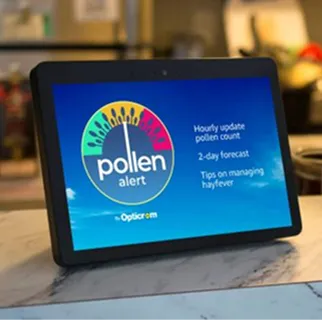
Hyper-local. It was the first voice skill to use hyper-local data to alert people to high pollen counts in their own postcode. No more generic regional forecasts.
On demand or on autopilot. Users could ask for the pollen count whenever they liked, or add it to their Alexa flash briefing so it arrived with the morning news.
A human voice. Instead of Alexa's standard voice, the skill used a professional voice-over artist. It sounded like a helpful person, not a robot reading a weather table.
Made for screens too. Mindshare created a visual identity so the skill looked as good as it sounded on screen-enabled Alexa devices like the Echo Show.
Opticrom Hayfever 2% w/v Eye Drops, solution. Contains sodium cromoglicate. Always read the label.
How we made it useful
Health brands have to earn their place in someone's morning. So we kept the focus on usefulness first and branding second.
Short and to the point. Nobody wants a lecture before breakfast. Answers were designed to be quick to hear and easy to act on.
Tested with real people. Our process includes one-to-one user testing, so we can hear how people actually talk to a skill rather than guess.
Measured from day one. Voice analytics show what people ask, when they ask it and where they drop off, so the experience can keep improving through the season.
The takeaway
Pollen Alert was built around a real question asked at the right moment. It didn't try to sell eye drops in every sentence. It set out to earn trust by being genuinely useful, every morning, all season long.
For any health or wellness brand, that's the lesson. Find the daily question your customers already ask, answer it brilliantly, and let the brand ride along.
Read the original launch announcement: Sanofi’s Opticrom teams with Mindshare to launch UK’s first voice-activated pollen alert (MarComm News).
Want your brand to be the first thing customers hear in the morning? Talk to Voxly Digital.
Additional links
- Pollen survey 2018 (Met Office)
- Sanofi’s Opticrom teams with Mindshare to launch UK’s first voice-activated pollen alert (Marcomm News)