The brief
Sighted people have questions about sight loss. Lots of them. Can you dream? How do you pick up after your guide dog? Does a blind person see black?
Most never ask, because it feels awkward. And the ones who do ask tend to ask a stranger at a bus stop, who has heard it all before and just wanted to get home.
RNIB, the UK's leading sight loss charity, wanted to change that. Its #BeforeYouAsk campaign, the next phase of See the Person, Not the Sight Loss, used humour and everyday scenarios to tackle myths about blindness. The brief from RNIB and Wavemaker UK was to give the curious public somewhere to take their questions instead.
Wavemaker's innovation team led the strategy and creative. Voxly Digital led the UX, build, hosting set-up and analytics, working alongside RNIB and the campaign's cast of blind and partially sighted people.
“People are curious about sight loss, but lots of them worry about saying the wrong thing. #BeforeYouAsk gave them a safe space to ask anything and hear the answer from someone who lives with it. Voxly Digital turned our idea into an accessible, mobile-first experience in a matter of weeks, with RNIB’s community involved at every step.”

Part of RNIB's biggest-ever campaign
#BeforeYouAsk sits inside See the Person, Not the Sight Loss, which RNIB calls its biggest-ever advertising campaign.
It launched in October 2022 with The&Partnership, built around RNIB research showing that the biggest barrier blind and partially sighted people face is public misperception. Its film follows Ava, a teenage gamer coming to terms with losing her sight. The 60-second ad premiered in a Coronation Street break, and Wavemaker UK, RNIB's media agency, even got the Gogglebox cast watching it on Channel 4.
The second phase, #BeforeYouAsk, added six short films, a radio ad, a quiz and a Be Helpful guide. Our video chat gave that phase a place for curiosity to go: the coaching part of the plan, giving people the tools to build their own connections with blind and partially sighted people in real life.
Why awkward questions need a safe space
There are more than two million people living with sight loss in the UK. Yet plenty of sighted people still don't know how to talk to them.
RNIB's own research found that 60% of sighted people feel nervous or awkward about approaching someone with sight loss to offer help. Nervous people stay quiet, and myths survive.
Our starting point was simple. People will ask a screen things they would never say out loud to a person. Take away the fear of looking ignorant, and the questions start flowing.
Three ideas, one winner
Wavemaker and Voxly Digital put three concepts in front of RNIB.
An interactive video chat. Real people with sight loss answer the public's most common questions on camera, in a mobile-first, video-call style experience.
An AI assistant you help train. A blurred avatar that gets smarter, and comes into focus, as people feed it questions.
Phone a friend, with a twist. A blind AI friend on WhatsApp who answers your questions and asks a few of its own, like why sighted people grab a blind person's arm to cross the road.
RNIB chose the video chat. It put real faces and real voices front and centre, which is exactly what "See the Person" is about. It could also be ready in time for the campaign launch, while the bolder AI ideas fed into a longer-term roadmap.
Sourcing the questions people really ask
A Q&A is only as good as its questions. So we didn't guess.
The question list was built from RNIB's own community, AnswerThePublic and wider internet research. Mobile Marketing reported that the final tool covers more than 40 questions sourced from people with sight loss, AnswerThePublic, Reddit and Google's predictive search.
The answers come from the campaign's blind and partially sighted cast, filmed going about everyday tasks while they talk. Wavemaker wrote the director's guidance and reviewed the scripts for tone, with RNIB signing off the final list. The result feels like a chat with a person, not a lecture from a charity.
How the video chat works
Visitors pick one of three topics: Our sight loss, Our experiences and daily life or Our helpful tips. A video answer plays straight away, with the question written alongside it.
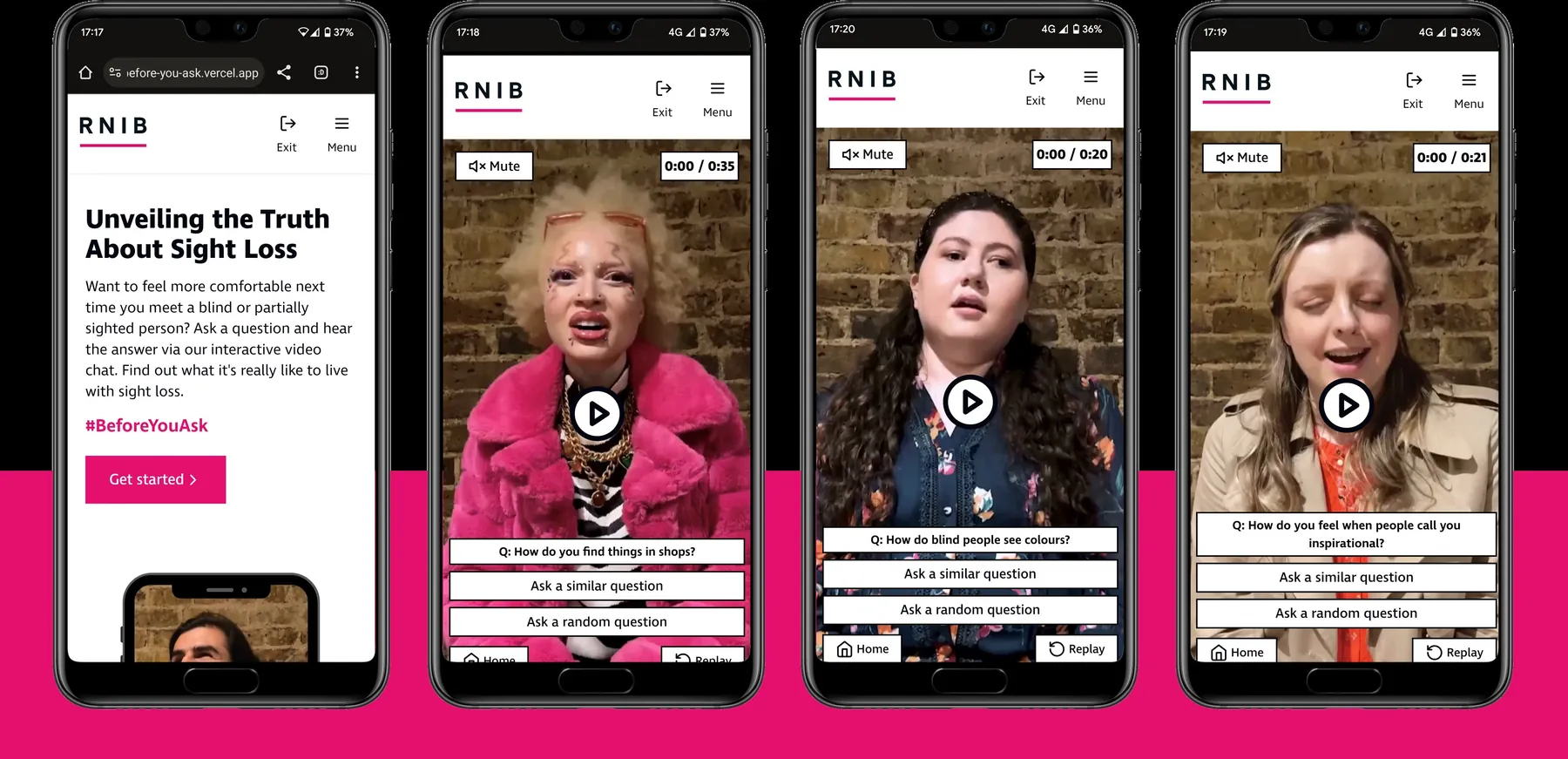
From there, two buttons keep the conversation going: Ask a similar question and Ask a random question. It feels like a video call that never runs out of things to talk about.
Replay, mute and home controls sit where you'd expect them. Persistent links to donate, get involved and stay in touch turn curiosity into support for RNIB.
Accessibility from day one
Building for RNIB means accessibility isn't a box to tick at the end. It is the job.
RNIB's accessibility specialists reviewed the work at three checkpoints: wireframes, front-end design and build, and user acceptance testing. Every control is a large, clearly labelled button. A dark mode switch sits at the top of every screen, and an exit button is always one tap away.
The experience lives on an RNIB subdomain, so it feels like part of RNIB, and the charity stays in control of its data, with Voxly Digital acting as data processor.
The takeaway
#BeforeYouAsk worked because it lowered the stakes. Nobody wants to be the person who asks the awkward question. Give them a safe space and real people to hear from, and they'll ask.
For charities, the lesson is to start with people, not tech. The most powerful thing in this project wasn't the code. It was the cast, speaking for themselves.
Got a question your audience is too shy to ask? Talk to Voxly Digital.
Additional links
- Try the #BeforeYouAsk interactive video chat (RNIB)
- See the Person, Not the Sight Loss (RNIB)
- RNIB launches See the Person, Not the Sight Loss campaign (RNIB)
- RNIB launches #BeforeYouAsk interactive video chat experience (Mobile Marketing)
- Expanding our campaign to raise awareness of sight loss with #BeforeYouAsk (RNIB)
- A simple hello works best (RNIB)
- Key information and statistics on sight loss in the UK (RNIB)