The brief: give the silent service a human face
In military recruitment, the first conversation often decides everything. For the Royal Navy's Submarine Service, that conversation is harder than most. How do you explain months under the sea, and life in the "silent service", to someone who has never given it a second thought?
Candidates have very specific questions, about technical roles, time away and what daily life is really like. FAQ pages can't answer them in the moment. And the Navy can't afford to lose interested people: in 2023–24, it recruited 2,450 people against a target of 4,040.
The Navy already had a successful text-based AI guide. The brief from the Royal Navy and its media agency Wavemaker was to take the next step: turn that guide into a high-fidelity digital avatar that feels personal and human, and is ready to talk any time of day. Atlas launched in Q4 2025.
“It will never replace our career advisors or that human contact, but it’s there to be a guide to help when it can. We always want it to be as genuine as we possibly can. That’s why we never use actors.”

From text box to digital human
Atlas didn't start from scratch. It's the latest stage of a multi-year recruitment programme that began with the Navy's AI Virtual Recruitment Guide, a chatbot Voxly Digital built for the careers website.
That guide proved the appetite was huge. According to WPP, more than 165,000 people used it, asking over 460,000 questions, and satisfaction reached 93% once a full large language model was introduced. Traffic to live agents fell by 76%.
Those numbers gave us the confidence, and the data, to move from a text box to a digital human.
Meet Atlas
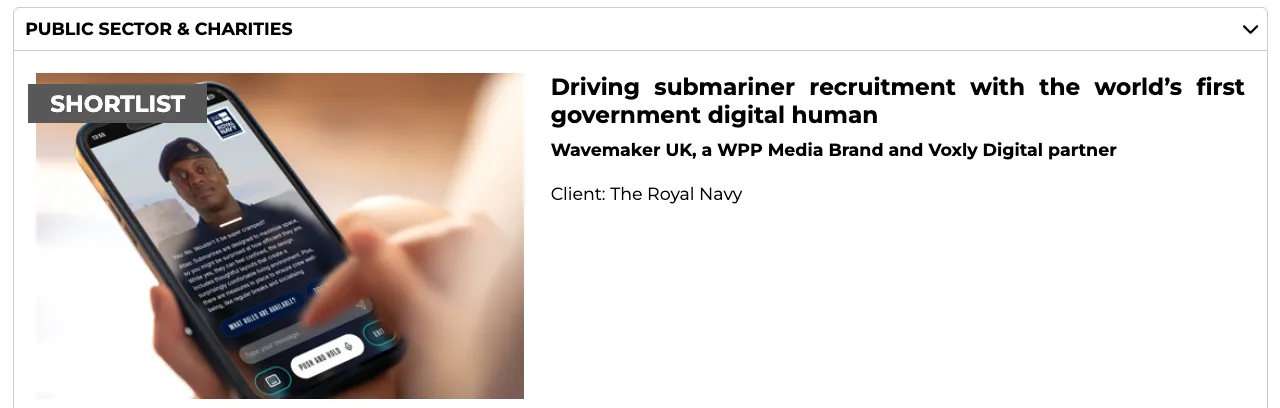
Atlas is a conversational avatar whose image and voice are based on a real, serving submariner. He gives the silent service a human face, and can answer detailed questions about the recruitment journey at any hour.
A trustworthy brain. We built Atlas on large language models and retrieval-augmented generation (RAG). He draws only on approved Royal Navy content, so his answers stay accurate and on-message. Candidates can talk to him by voice or by text.
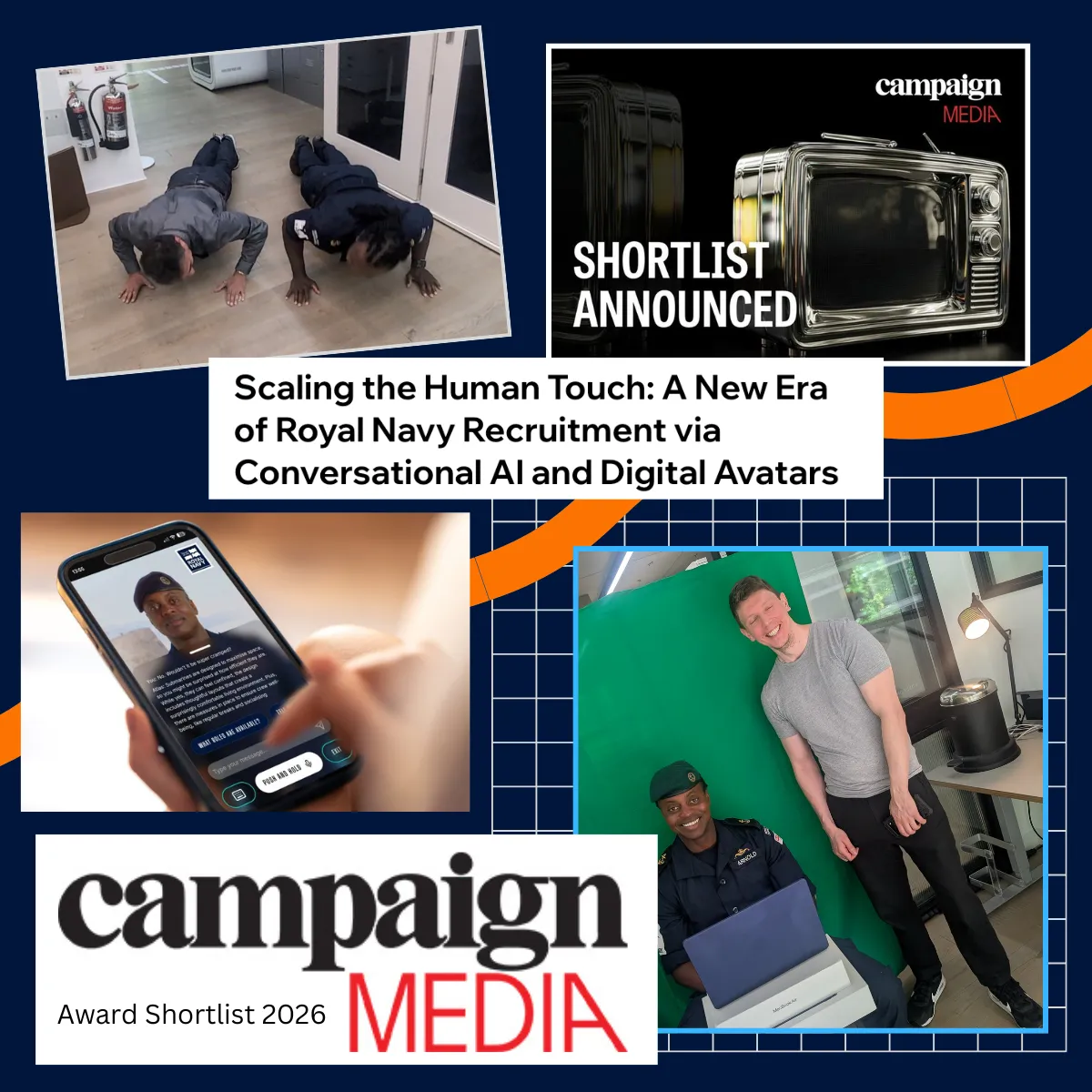
A real person behind the face. Rather than hire an actor, we helped coordinate filming with a serving member of the Submarine Service. Voxly Digital then managed the process of turning that footage into a generative AI avatar, refining gestures and tone until Atlas felt like a genuine representative of the Service.
A clear identity. Atlas is always presented as an AI avatar. Nobody is tricked into thinking they're chatting to a sailor on shore leave.
Video and images by Wavemaker UK.
Built to support people, not replace them
Young candidates still want people. Research from Reed Talent Solutions found that 77% of Gen Z job seekers felt frustrated when they couldn't speak to someone directly during recruitment.
That's why Atlas was designed as a guide, not a gatekeeper. He handles the questions candidates want answered right now, especially when career advisors aren't available, and leaves the deeper conversations to the Navy's recruiters. The team also tested Atlas with diverse groups to make sure he works for everyone the Navy wants to reach.
Shortlisted for the Campaign Media Awards
Atlas was shortlisted for the 2026 Campaign Media Awards, a nice nod for a project that lives or dies on trust.
Is your organisation ready for a digital human?
Moving from traditional digital tools to an avatar like Atlas takes more than budget. The Royal Navy weighed up three questions.
Is the technology ready? Old chatbots frustrated people with rigid scripts. Today's AI can handle nuance and complex information reliably. But it has to be good enough that people come back because it's genuinely quicker than a search bar, not just to try a gimmick.
Are your users ready? The Navy's earlier AI programmes showed candidates wanted fast, personal answers, not static PDFs. If your data shows the same appetite, your audience is primed for a more human digital experience.
Is your brand ready? New tech should reinforce how you already treat people. For the Navy, Atlas was an extension of its promise of specialist, round-the-clock support, not a departure from it.
The takeaway
Atlas shows that a digital avatar works best when it's built on real data, real people and a clear job to do. The Navy didn't chase novelty. It took a chatbot that candidates already loved and gave it a face they could trust.
For any organisation with a hard-to-explain offer, a digital human can bridge the gap between curiosity and commitment. Just make sure there's a real human ready when the conversation gets serious. Atlas has since been joined by a 24/7 AI voice agent that does the same job on the phone.
Fancy giving your brand a face that never needs shore leave? Talk to Voxly Digital.