The brief: answer the phone when the office is closed
People don't decide to join the Navy between 9 and 5. They may consider it late on a Sunday night, after a shift, or on a bank holiday when the family's asking what they're going to do with their life. For years, if those people picked up the phone out of hours, they got the same answer: we're closed, call back tomorrow.
Recruitment is a race against attention. A candidate who hits a closed line might call back. Or they might drift off to another career, another employer, another idea. Every unanswered call is a candidate the Navy has paid to attract and then lost at the last step.
Staffing a human phone team around the clock is expensive and hard to justify for overnight and weekend volumes. So the Royal Navy Recruitment Team asked Voxly Digital and Teleperformance, its recruitment contact centre partner, for a way to give callers a real answer at any hour, keep the tone people expect from the Service, and hand serious candidates to a human recruiter without losing them along the way.
“Atlas and our web chat showed us how much candidates value instant, accurate answers. Taking that onto the phone was the natural next step. Now, whenever someone calls us, day or night, they get a helpful conversation instead of a closed line, and our recruiters start the next morning with candidates who are already warmed up. The trial results made the move to a full rollout an easy decision.”

Building on a long partnership: web chat and Atlas
The voice agent wasn't a cold start. It's the latest step in a long-running programme between Voxly Digital and the Royal Navy to modernise how candidates get answers.
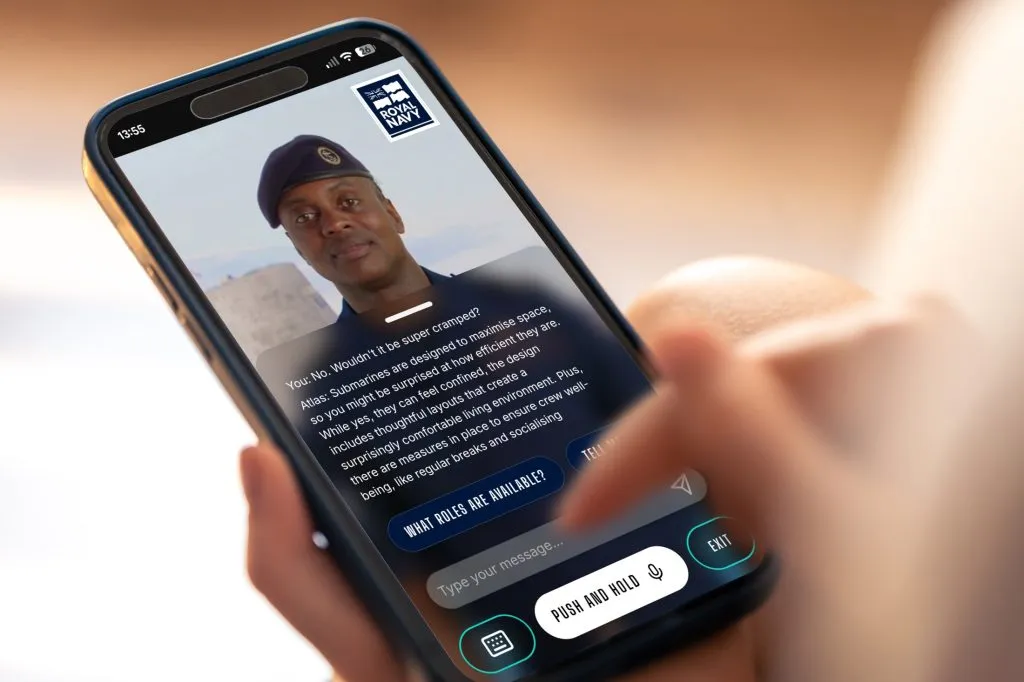
That work began with web chat on the recruitment site, which cut live chat support by 70% by giving candidates instant answers to common questions. It grew into Atlas, a digital avatar that gives the Navy a friendly, human face online and guides candidates through roles, eligibility and the application process.
Years of web chat and Atlas conversations gave us something most voice projects don't have on day one: a deep, tested understanding of what candidates actually ask, and how the Navy wants those questions answered. Extending that knowledge to the phone meant the voice agent spoke with the same accuracy and the same voice as the Navy's digital channels, from its very first call.
What we built: an AI voice agent for out-of-hours recruitment calls
Voxly Digital built the AI; Teleperformance brings the contact centre and the human advisors candidates speak to during office hours. The voice agent picks up calls on evenings, weekends and holidays and holds a natural conversation. It can:
- Answer questions about joining, the application process, roles, careers and benefits
- Explain eligibility rules on nationality, medical standards and age
- Cover the full family of services, from the Royal Navy and Royal Marines to the Reserves, Royal Fleet Auxiliary and Submarine Service
- Recognise when a caller wants a person and route them towards a human recruiter
- Log every conversation, so the Navy can see exactly what candidates want and when
Getting the feel right was the hard part. As Alexandre Vander Elst, Full Stack AI Engineer at Voxly Digital, puts it: “Voice is far less forgiving than chat. On a website, a two-second pause is fine. On the phone, it sounds like the line's gone dead.”
So the team tuned every step, from hearing the caller to thinking to speaking, to keep replies quick. We chose a warm, realistic voice that fits the Navy, and taught the agent to cope with background noise, regional accents and callers who talk over it. The aim: a conversation, not a phone menu.
Reading the transfer rate: a signal of intent
33.6% of out-of-hours callers asked to speak to a human. At first glance that looks like a gap. In fact, it's one of the most valuable findings of the trial.
These callers weren't browsing. They were ready to take the next step, often in the middle of an application. Some were returning daytime calls from recruiters after work. Others needed help with portal logins or verification links. Each of these is a high-intent candidate, and each points to a clear upgrade: give the agent the tools to finish the job, not just answer the question.
This matches what the wider research says. Gartner has found that only 2% of citizens choose an AI chatbot as their first-choice channel for government services. Winning trust means AI that knows when to hand over, and makes that handover seamless. That's exactly how we designed the Navy's service.
From trial to full rollout
The trial ran from November 2025 to July 2026. In August 2026, on the strength of what it showed, the Royal Navy moved to a full commercial rollout. The voice agent is now a permanent part of the recruitment operation, live every evening, weekend and bank holiday.
That step matters. Plenty of public sector AI pilots never make it past evaluation. This one did, because the data showed real demand from candidates and real value for the Navy.
Sarah Adams, Account Director at Teleperformance, sums up the change: phone lines used to close at the end of the day, and the voice agent “closed that gap”. Advisors now start each morning knowing what callers need and who's ready to move forward.
How government is using voice AI for citizen services
The Royal Navy is at the front of a fast-moving trend. Across the UK public sector, voice AI is moving from experiment to core infrastructure.
- Central government is building shared voice capability. DSIT's Gov Voice programme aims to create a cross-government, AI-enabled voice capability that central departments, councils and arm's-length bodies can all adopt. A contract award notice was published in September 2026.
- The DVLA has shown the scale of the prize. The agency handles around 900,000 calls a month. Its natural-language voice system cut call-navigation time from about three minutes to roughly 90 seconds.
- Accessibility is a priority. In June 2026, DSIT signed a memorandum of understanding with ElevenLabs, running to 2030, to explore how voice AI can make public services easier to use for people with visual impairments, low literacy or limited English.
- Councils are already answering around the clock. Derby City Council's AI phone assistant handled more than 100,000 calls and resolved 43% without a human advisor, while Hillingdon residents can now phone their council 24 hours a day.
- Leaders expect conversation to be the norm. Adobe's 2026 research found that 89% of public sector organisations believe future citizen experiences will need to be conversational, through AI chat and voice.
The pressure is financial as well as social. Government contact centres are being asked to find 15% efficiency savings over the 2025 Spending Review period. Voice AI that handles routine calls and widens access to evenings and weekends is one of the clearest ways to do both.
The takeaway
Interest doesn't keep office hours, so your front door shouldn't either. The Royal Navy proved that a voice agent can carry a trusted public brand, answer real questions at any hour, and know when to hand over to a human.
The bigger lesson is about building step by step. Years of web chat and Atlas conversations meant the voice agent knew what candidates ask from its very first call, and solid trial data turned an experiment into a permanent service. As departments and councils move to voice AI, that's the path we'd recommend. See more of our government AI work and our AI for customer self-service.
Want a voice agent that never clocks off? Talk to Voxly Digital.
Additional links
- Gartner: only 2% of citizens choose an AI chatbot first (IDM)
- Gov Voice programme tender (Find a Tender)
- In the spotlight: DVLA’s AI-powered contact centre transformation (Think Digital Partners)
- UK government signs AI partnership with ElevenLabs to improve accessibility of public services (Think Digital Partners)
- Transforming public sector communication with phone-based voice AI (ICS.AI)
- PwC and Hillingdon lead the way on AI for residents (The MJ)
- Public sector digital trends (Adobe)
- DVLA AI customer service transformation (Resultsense)